
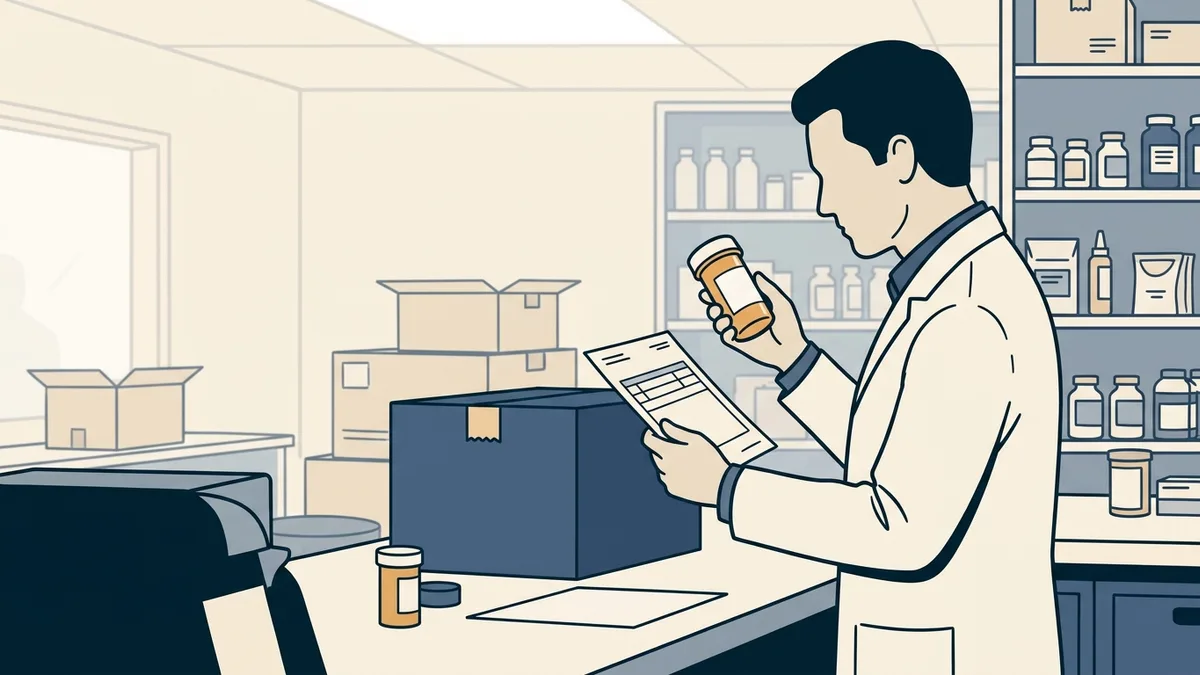
Pick a pharmacy licensed or permitted in every state you ship to, DEA-registered if you prescribe controlled substances, able to fill your formulary at volume, and willing to sign terms with no per-prescription payments, clear labeling rules for compounded products, patient choice, defined service levels and an orderly transfer of prescriptions at exit.
Choose a pharmacy partner that holds a pharmacy license or nonresident permit in every state where your patients live, holds a DEA registration if you prescribe controlled substances, will fill your full formulary at the volume you expect, and agrees to contract terms that keep money and marketing clean. Price per fill matters, but a cheap pharmacy that cannot ship to two of your launch states costs more than it saves.
Does the pharmacy need a license in the patient's state?
In general, yes. Most states require an out-of-state pharmacy that ships into the state to hold a nonresident pharmacy license or permit. Florida, for example, lets an out-of-state telehealth pharmacist registrant dispense only through a Florida-permitted pharmacy or a registered nonresident pharmacy or outsourcing facility (Fla. Stat. § 456.47(4)(g), referring to §§ 465.0156 and 465.0158). Ask for the pharmacy's license list with numbers and expiration dates, and check a sample against the state boards' lookup tools yourself.
What changes if you prescribe controlled substances?
- DEA registration. The dispensing pharmacy must hold a DEA registration at the location that dispenses.
- Corresponding responsibility. Under 21 CFR 1306.04(a), the prescriber is responsible for a legitimate medical purpose, "but a corresponding responsibility rests with the pharmacist who fills the prescription." Pharmacies refuse telehealth controlled-substance prescriptions they consider risky. Ask what the pharmacy's red-flag policy is, how often it rejects prescriptions, and how it communicates rejections to your clinicians.
- Identity verification for OUD treatment. Under DEA's buprenorphine telemedicine rule (90 FR 6504), the pharmacist must verify the identity of the patient before filling a prescription issued under that rule. Confirm the pharmacy's process.
- After 2026. If the Special Registration for Telemedicine is finalized, the pharmacy side may carry new obligations. The rule was proposed in January 2025 and sent to OIRA on August 25, 2026; plan around it on our DEA telemedicine rules hub.
Compounded or commercial products: what is the difference for a partner?
Commercially manufactured drugs can be filled by any licensed retail or mail-order pharmacy. Compounded drugs come from two different federal pathways, and the difference decides what the pharmacy can do for you.
- 503A pharmacies (21 U.S.C. 353a) compound based on a prescription for an identified individual patient. They may not compound "regularly or in inordinate amounts" drugs that are essentially copies of a commercially available drug product, unless the prescriber determines that a change produces a significant difference for that patient (§ 353a(b)(1)(D) and (b)(2)). State boards of pharmacy are the primary regulators.
- 503B outsourcing facilities (21 U.S.C. 353b) register with FDA, are subject to current good manufacturing practice requirements and FDA inspection, and report the products they compound.
If your service line relies on compounded drugs, the partner's compliance posture is your exposure too. Read compounded GLP-1s after the shortages ended before you sign anything for a weight-loss program.
Which contract terms keep the arrangement clean?
- No payment per prescription to you. A pharmacy paying a prescribing practice for prescriptions it sends raises anti-kickback questions under 42 U.S.C. 1320a-7b(b) when federal health care program business is involved, and many states have their own fee-splitting and kickback rules. Florida's medical practice act, for instance, lists split-fee arrangements for patients referred to pharmacies as grounds for discipline (Fla. Stat. § 458.331(1)(i)). Any fee between you and the pharmacy should be for a defined service at fair market value, reviewed by counsel.
- Patient choice. Several states protect a patient's right to choose a pharmacy. Your intake should let patients send a prescription elsewhere.
- Labeling and branding. FDA's June 2026 warning letters objected to websites that showed the telehealth company's name on pictured labels of compounded products the company did not make. The label belongs to the pharmacy that compounds. Agree in writing on what product images and names you may use.
- BAA where needed. A pharmacy filling prescriptions for treatment is generally a covered entity in its own right, but if it provides other services to you (patient messaging, refill reminders, data reports), a BAA may be required for those functions.
- Service levels. Fill time, shipping time by region, cold-chain handling for refrigerated products, and how lost or damaged shipments are replaced.
- Exit. Transfer of open prescriptions to a new pharmacy on termination, with patient notice.
Questions for the diligence call
- Which states are you licensed in, and which applications are pending?
- Are you a 503A pharmacy, a 503B outsourcing facility, or both? Can we see your most recent state inspection and, for 503B, FDA inspection results?
- What share of telehealth controlled-substance prescriptions do you reject, and why?
- What do you need from our prescribers on each prescription for a compounded product?
- Who handles patient questions about side effects, and how are those routed back to our clinicians?
- Have you received an FDA warning letter or state board action in the last five years?
Should a practice use more than one pharmacy?
Often. A primary partner for most states and a backup for the states the primary does not cover, or for controlled substances it will not fill, avoids stranding patients. Two pharmacies also mean two sets of terms to track. Put both on your compliance calendar.
Our Platform, Pharmacy & Lab Selection service ($2,450) runs license, registration and contract checks on your shortlist. Fees paid to vendors are separate. See pricing.
Common questions
- Does a mail-order pharmacy need a license in every state it ships to?
- Generally yes. Most states require an out-of-state pharmacy shipping into the state to hold a nonresident pharmacy license or permit. Ask for the full license list and verify samples on each state board's lookup site.
- What is the difference between a 503A and a 503B pharmacy?
- A 503A pharmacy compounds for identified individual patients under 21 U.S.C. 353a and is primarily regulated by state boards. A 503B outsourcing facility registers with FDA under 21 U.S.C. 353b and is subject to current good manufacturing practice requirements and FDA inspection.
- Can a pharmacy pay a telehealth company for prescriptions?
- Payments tied to prescription volume raise federal anti-kickback concerns when federal program business is involved, and many states prohibit fee-splitting for referrals to pharmacies. Any fee should be for a defined service at fair market value and reviewed by counsel.
- Why do pharmacies reject telehealth controlled-substance prescriptions?
- Under 21 CFR 1306.04(a), the pharmacist who fills a controlled-substance prescription carries a corresponding responsibility for its legitimacy. Pharmacies apply red-flag policies, and telehealth prescriptions often get extra scrutiny.
Planning a Telehealth Service Line?
We research every state's rules for your service line, write the policies and consent forms, file telehealth registrations and keep it current, at published prices.