
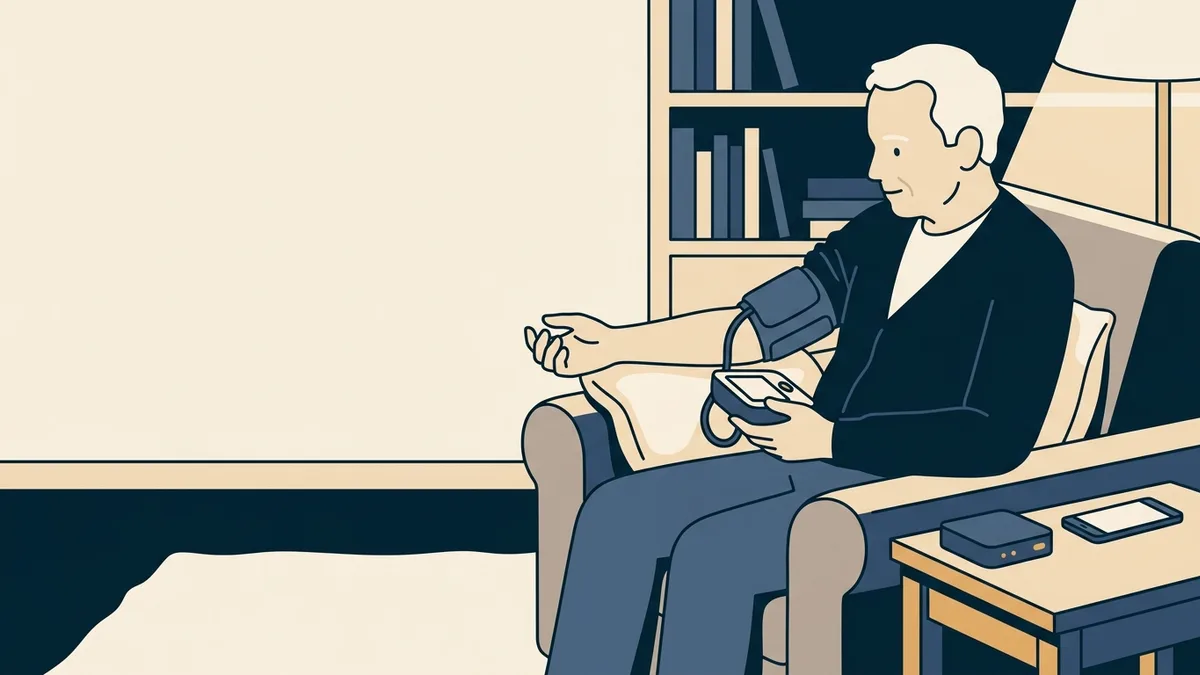
Build every Medicare condition into the workflow: established patients, documented consent, an FDA-defined device, 2 to 15 or 16 to 30 days of data per 30-day period, monthly live interactive communication, one billing practitioner, and supervised clinical staff. CMS proposed for 2027 an initiating visit and that clinical staff be direct employees of the practice.
Set up a remote patient monitoring (RPM) program by building each Medicare condition of payment into the workflow, so that the monthly claim is true by default: the patient is established, consent is documented, the device meets the FDA definition of a device, data is transmitted on enough days, someone has a live interactive conversation with the patient, only one practitioner bills, and clinical staff work under the billing practitioner's supervision. Then watch the proposal CMS made for 2027, which would require that clinical staff be direct employees of the practice.
This is the operational side. For codes and claims, our sister company White Glove Medical Billing handles billing questions.
Which patients qualify?
- Established patients only. CMS restored the established-patient requirement for RPM when the COVID-19 public health emergency ended (CY2021 physician fee schedule final rule, 85 FR 84542 through 84546).
- A clinical reason to monitor. RPM may be used for acute and chronic conditions, but the reason has to be documented and the data has to inform a treatment plan. A practice that enrolls every patient with a diagnosis code is the pattern OIG flagged.
- Consent. CMS has stated that patient consent is required at the time RPM services are furnished (CY2024 fee schedule final rule). Document it, including the patient's cost-sharing responsibility.
- Proposed for 2027: an initiating visit. The CY2027 proposed rule (91 FR 43842) would require the billing practitioner to furnish a separately reportable face-to-face visit, in person or by telehealth, at the onset of RPM, at which RPM is discussed.
Which devices qualify?
For both RPM and RTM, CMS requires that the device meet the definition of a device in section 201(h) of the Federal Food, Drug, and Cosmetic Act, and RPM data must be physiologic and digitally uploaded, not typed in by the patient. Cellular devices that transmit automatically remove the most common failure, which is a patient who forgets to sync. See choosing an RPM device vendor.
How many days of data are needed?
Since January 1, 2026, the device supply codes come in two lengths per 30-day period: 2 to 15 days of data (CPT 99445) and 16 to 30 days (99454). They are not additive; you bill one or the other for the period. Under CMS's earlier clarification (CY2024 final rule), only one practitioner may bill the device supply and setup codes for a patient in a 30-day period, even if the patient uses several devices. See what the 2-to-15-day codes change.
How should treatment management time be spent?
Treatment management is now coded as the first 10 minutes (99470), the first 20 minutes (99457), and each additional 20 minutes (99458) in a calendar month. In the CY2026 final rule, CMS adopted the CPT language that these codes "require a live, interactive communication with the patient/caregiver," which contributes to but need not make up all of the time. The CY2026 final rule did not exclude any particular type of communication, so long as it meets the CPT specification. Time cannot be counted twice across RPM and other care management services.
Who may do the work, and under what supervision?
Since 2020, CMS has treated RPM treatment management as a care management service whose clinical staff work may be furnished under general supervision of the billing practitioner, rather than direct supervision. That is the rule outsourced RPM companies have relied on.
The CY2027 proposal would change it. CMS proposed to pay for RPM and RTM only when furnished by clinical staff who are direct employees of the practitioner or the practitioner's practice, under general supervision and meeting the incident-to rules at 42 CFR 410.26, starting January 1, 2027 if finalized. CMS said this would not require staff to be physically located in the practice. If your program uses a vendor's nurses, read the 2027 direct employee proposal before you sign anything long term.
What did OIG find, and how do you avoid it?
OIG's September 2024 report (OEI-02-23-00260) found that about 43 percent of Medicare enrollees who received RPM did not receive all three components: education and setup, device supply with data transmission, and treatment management. Its August 2025 follow-up (OEI-02-23-00261) found Medicare RPM payments exceeded $500 million in 2024, with nearly 1 million enrollees, and proposed monitoring measures including a high share of enrollees with no prior history with the billing practice and billing for multiple devices per enrollee per month. See what OIG found.
Build the program so that a patient who is not getting treatment management is noticed and either re-engaged or discharged from RPM, rather than billed for device supply alone month after month.
Can RPM be combined with other services?
CMS allows RPM or RTM, but not both, to be billed alongside one of chronic care management, transitional care management, behavioral health integration, principal care management or chronic pain management for the same patient, as long as time and effort are not counted twice. Chronic care management and RPM together are common for patients with hypertension and diabetes.
The setup checklist
Clinical design
- Conditions and enrollment criteria, signed by the medical director.
- Parameters monitored per condition, alert thresholds, and who responds to each alert within what time.
- Escalation path for out-of-range readings, including after-hours.
- Discharge criteria: goals met, non-adherence, patient request.
Enrollment workflow
- Established-patient check in the EHR before enrollment.
- Initiating visit at which RPM is discussed and documented, which is good practice now and proposed as a requirement for 2027.
- Consent covering the service, data use, and cost sharing.
- Device education and setup documented (99453).
Monthly operations
- Data days counted automatically per 30-day period, with outreach when a patient is falling short.
- Scheduled interactive communication each month, logged with time and content.
- Treatment plan changes documented when data warrants.
- Check that no other practitioner is billing RPM for the patient.
Staffing and contracts
- Clinical staff roster with employment status, in light of the 2027 proposal.
- Supervision documented under 42 CFR 410.26.
- Device vendor BAA, data ownership and exit terms.
- No vendor fees that vary with the number of Medicare patients enrolled; have counsel review any per-patient pricing.
Audit readiness
- Monthly report of patients billed for device supply without treatment management.
- Report of enrollees with no visit history in the practice before RPM.
- Report of patients with more than one device billed in a month.
- Annual chart audit of a sample of RPM months against every condition above.
What should patients be told before they enroll?
Consent is a condition of payment, but a good enrollment conversation also prevents the complaints and drop-off that make programs fail. Cover:
- why the clinician recommends monitoring, and for how long;
- what the patient has to do (take readings, keep the device charged, answer monthly calls);
- who will contact them, how often, and what happens when a reading is out of range;
- that RPM is a Medicare Part B service, so the usual Part B cost sharing generally applies each month unless supplemental coverage pays it;
- how to stop, and what happens to the device when they do.
Patients who understand the monthly cost and the purpose stay enrolled longer, and the ones who would not have stayed are better off not starting.
How do you size and staff the program?
Work backward from the monthly interactive communication and alert review. For each enrolled patient, estimate the minutes of clinical staff time per month for outreach, data review, alert response and documentation, then add time for onboarding new patients and replacing devices. That gives a caseload per nurse or medical assistant at your own pace, which is a better planning number than a vendor's estimate. Pilot with a small cohort, measure the real minutes, and only then expand. If the 2027 direct employee proposal is finalized, this staffing model is the program; if it is not, it is still the benchmark for judging what a vendor's service is worth.
Is RPM worth starting now, with 2027 changes pending?
For practices with a chronic disease panel and their own nursing staff, the proposals mostly codify good practice. For practices that planned to outsource the whole program to a vendor's staff, wait for the final rule, expected in early November 2026, before signing a long contract. Also see RTM versus RPM if your patients' data is therapeutic rather than physiologic.
Our Remote Patient Monitoring Program Setup ($5,950) delivers the protocols, consent, workflow, vendor review and audit reports above, updated for the final CY2027 rule. Device costs are separate. See pricing.
Common questions
- Can a new patient start remote patient monitoring?
- Not under current Medicare rules. CMS requires RPM to be furnished to established patients. The CY2027 proposed rule would also require a face-to-face initiating visit, in person or by telehealth, at which RPM is discussed, and would extend the established-patient rule to RTM.
- How many days of readings does Medicare RPM require?
- Since 2026 there are two device supply codes per 30-day period: CPT 99445 for 2 to 15 days of data and CPT 99454 for 16 to 30 days. Only one is billed per period, and only one practitioner may bill device supply for a patient in that period.
- Can an outside company's nurses do RPM for my practice?
- Under current rules clinical staff may work under general supervision. CMS proposed for 2027 that RPM and RTM be paid only when clinical staff are direct employees of the billing practitioner or practice. Watch the final rule, expected in early November 2026, before signing long vendor contracts.
- Does RPM treatment management require talking to the patient?
- Yes. CMS adopted the CPT language that the treatment management codes require a live, interactive communication with the patient or caregiver each month. That communication counts toward the time but need not make up all of it.
Planning a Telehealth Service Line?
We research every state's rules for your service line, write the policies and consent forms, file telehealth registrations and keep it current, at published prices.