
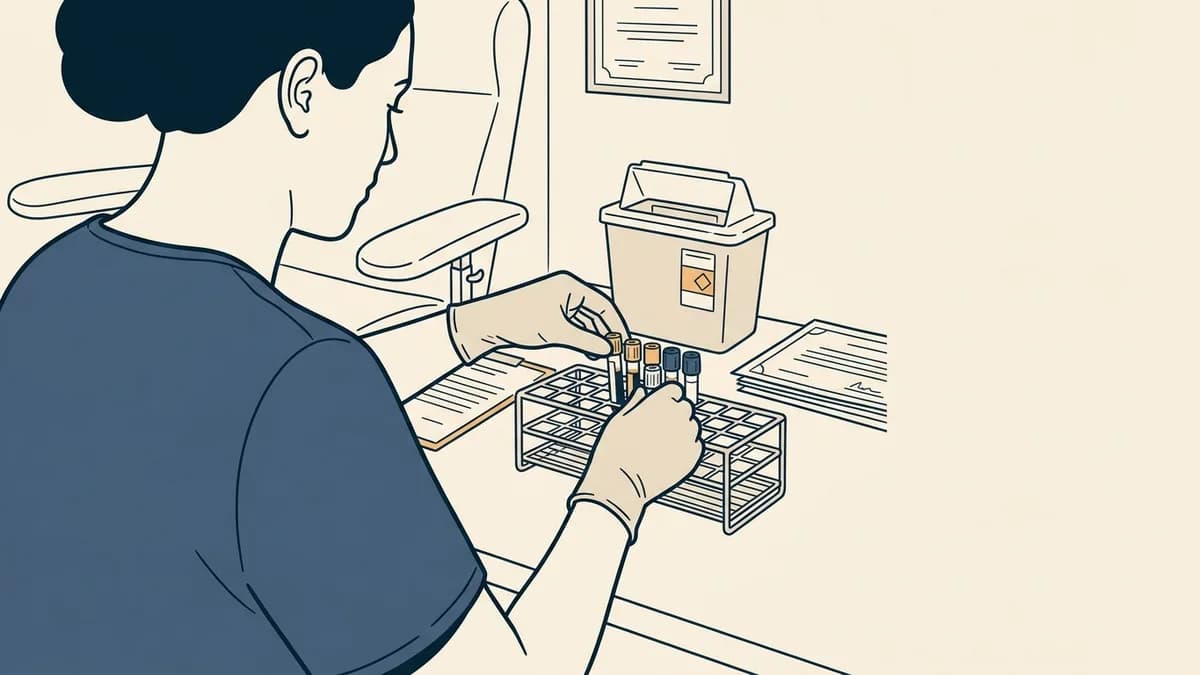
A telehealth lab partner must reach every patient through draw sites, home kits or both, test legally for every state you serve, including New York's separate lab permit, and route results electronically to the ordering clinician with critical values phoned to a reachable, licensed clinician. Test the full results loop with dummy orders before launch.
A lab partner for a telehealth practice has to do three things: collect a specimen from every patient you treat, test it legally for every state those patients live in, and route results back to the clinician who ordered them, with abnormal values flagged fast. Most failures happen on the third point, not the first two.
Draw sites or home collection kits?
National reference labs run patient service centers where patients walk in with an electronic order. Home collection kits (finger-stick blood, dried blood spot, swabs, urine) are mailed to the patient and back to the lab. Many practices use both.
- Draw-site networks handle almost any test, including venous panels that cannot be run from a finger stick. Coverage is uneven in rural areas; map your patients' ZIP codes against the lab's locations before you sign.
- Home kits reach patients anywhere a mail carrier goes, but each kit is validated only for specific analytes and specimen types. Ask the lab for its validation data for each test you plan to order from a kit, and the rejection rate for kit specimens (hemolyzed, insufficient quantity, delayed in transit).
Which licenses and certifications should the lab hold?
- CLIA. Any lab testing human specimens for diagnosis or treatment must hold a CLIA certificate appropriate to the complexity of the tests (42 CFR part 493). Ask for the certificate number and type.
- State licenses. Some states license clinical labs on top of CLIA. New York is the one that catches telehealth practices: under Public Health Law § 574 and 10 NYCRR 58-1.10, a lab testing specimens collected in New York generally needs a New York State clinical laboratory permit or approval for the specific test. If you treat New York patients, confirm the lab's New York permit covers every test on your order set.
- Kit regulation. A home collection kit can be an FDA-regulated device in its own right. The FDA's rule treating laboratory developed tests as devices was vacated by the Eastern District of Texas on March 31, 2025 (American Clinical Laboratory Association v. FDA), but that ruling concerned the tests, not every collection device. Ask the lab how each kit it ships is cleared or authorized.
How should results reach the clinician?
This is the part to test before launch, not after. Run a dozen dummy orders through the full loop and watch where results land.
- Electronic interface. Results should post to the patient's chart in your EHR or telehealth platform, matched to the right encounter, not to a shared inbox or a PDF portal someone checks on Fridays.
- Critical values. The lab calls critical results to a person. Give the lab a 24/7 phone number that reaches a clinician licensed in the patient's state, and write down who answers it on weekends.
- Ordering-clinician match. In a multi-state practice the clinician who ordered may be off; set a coverage rule for who reviews results when the orderer is away.
- Patient release. Under the 21st Century Cures Act information blocking rules, many results are released to the patient portal promptly. Decide how clinicians will contact patients about abnormal results before the patient sees them alone.
Which terms belong in the lab contract?
- A business associate agreement if the lab performs services for you beyond testing (patient outreach, kit fulfillment, data reports).
- Billing model: does the lab bill the patient's insurer, the patient, or you? If it bills you and you rebill the patient, check state rules on markups and direct billing before you set prices.
- No payments from the lab tied to test volume. Referral payments raise federal anti-kickback issues where federal program business is involved and state fee-splitting issues everywhere.
- State coverage list, including any state where specimens cannot be accepted.
- Turnaround time by test, and service credits if it slips.
- Critical value call policy and escalation path.
- Specimen rejection policy and who pays for the recollection kit.
Which service lines lean hardest on labs?
Weight management (baseline metabolic panels before some prescriptions), hormone therapy (monitoring levels and hematocrit), and anything with a drug that has lab-monitoring language in its labeling. See running a compliant telehealth weight-loss program and telehealth hormone therapy clinics.
Labs are one of three vendor decisions we run together in Platform, Pharmacy & Lab Selection ($2,450). See also choosing a telehealth platform and pricing.
Common questions
- Do labs need a special permit for New York patients?
- Generally yes. Under New York Public Health Law § 574 and 10 NYCRR 58-1.10, a laboratory testing specimens collected in New York must hold a New York State clinical laboratory permit or have approval for the specific test.
- Are home lab kits as reliable as a blood draw?
- Only for the analytes and specimen types the lab has validated. Ask for validation data for each kit test and the lab's rejection rate for kit specimens, which are more likely to be insufficient or delayed in transit.
- Who should get critical lab values in a telehealth practice?
- A clinician licensed in the patient's state who can act on them at any hour. Give the lab a 24/7 number and a written coverage rule for when the ordering clinician is unavailable.
Planning a Telehealth Service Line?
We research every state's rules for your service line, write the policies and consent forms, file telehealth registrations and keep it current, at published prices.